
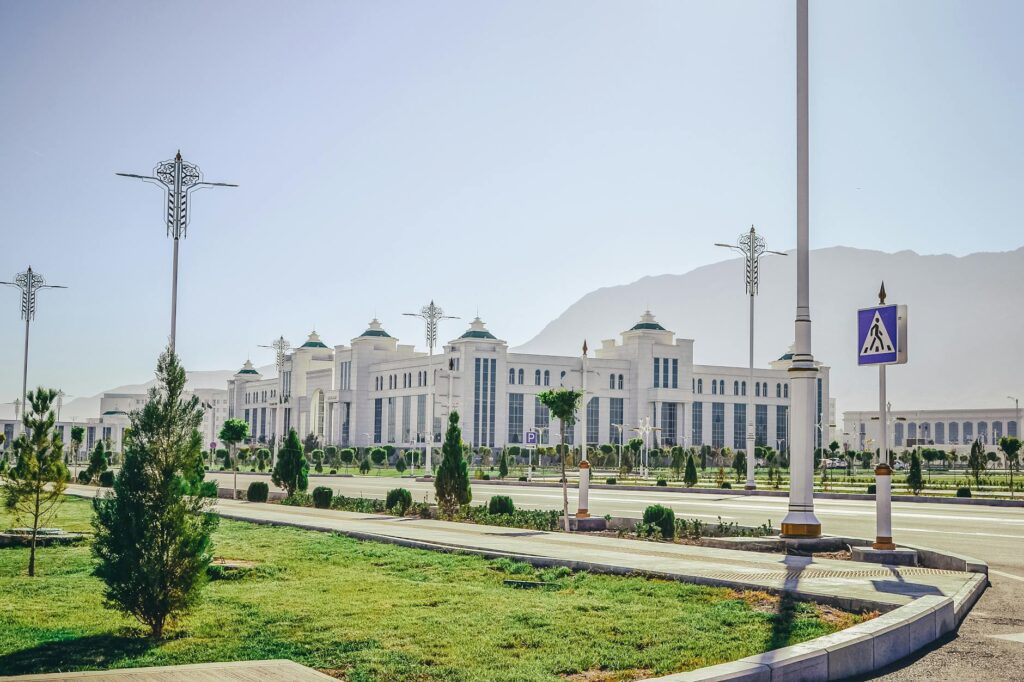
Ashgabat: Turkmenistan’s Marble Mirage
Ashgabat, the capital of Turkmenistan, stands as a testament to ambitious urban development, a city literally built of white marble. Its streets are lined with grand, often unoccupied, structures, reflecting a unique national vision. This architectural spectacle, however, prompts a deeper inquiry: what lies beneath the gleaming surface of this Central Asian metropolis? While international exhibitions like the White City Ashgabat 2026 showcase its developmental aspirations, a closer examination reveals a city where monumental ambition intersects with stark realities, challenging common perceptions of urban living and national progress.
Last updated: April 20, 2026
Ashgabat, Turkmenistan’s capital, is a city defined by its extraordinary use of white marble, having set a Guinness World Record for the highest density of marble-clad buildings. This architectural choice dominates the urban landscape, creating a visually striking, albeit often sterile, environment.
The Architectural Spectacle of Ashgabat
Ashgabat’s skyline is an arresting sight, dominated by an almost unbelievable amount of white marble. This architectural choice isn’t merely aesthetic. it’s a deeply embedded national policy. The city holds the Guinness World Record for the highest concentration of marble-clad buildings, a title it has held since at least 2015. According to Global Voices (2026), this extensive use of marble is a deliberate statement of national pride and prosperity, projecting an image of wealth and modernity on a global stage. The sheer scale is staggering. vast boulevards are flanked by colossal, often empty, government buildings, monuments, and residential complexes, all clad in the same luminous stone. This uniformity creates a surreal, almost dreamlike quality, leading some to describe Ashgabat as a city built from a single, colossal block of marble.
The architectural philosophy behind Ashgabat’s design is rooted in a desire to create a ‘White City,’ a concept that has been central to urban planning for decades. This vision was amplified by the Turkmenistan government’s commitment to showcasing the nation’s achievements and economic potential. The XXIII International Exhibition “White City Ashgabat” in April 2026, as reported by Turkmenportal.com (2026), works as a recurring platform to highlight these developments and attract potential investment, further cementing the ‘White City’ identity.
Contrasting Realities: The Economy and Governance
While Ashgabat’s marble facade suggests immense wealth, the reality for many Turkmen citizens is different. Turkmenistan is an authoritarian state with a highly centralized economy heavily reliant on its vast natural gas reserves. According to the U.S. Department of State (2023), the government maintains strict control over most sectors of the economy, limiting private enterprise and foreign investment. This economic model, while generating significant revenue for the state, hasn’t translated into widespread prosperity for the general population. Reports from organizations like Human Rights Watch consistently highlight concerns about human rights abuses, lack of political freedoms, and economic disparities. The lavish spending on monumental architecture in Ashgabat is often seen as a display of state power and a distraction from underlying economic and social issues. The city’s grandeur, therefore, exists in a peculiar tension with the lived experiences of many outside its marble-clad perimeters.
The government’s approach to urban development and national image is further exemplified by the regular hosting of international exhibitions. The “White City Ashgabat” expo — which has seen editions like the XIX in April 2026 and the XXIII in April 2026, works as a key platform for the regime to project an image of progress and stability. As noted by business.com.tm (2026), these events are framed as opportunities for ‘Global Dialogue to Practical Urban Transformation,’ aiming to attract international attention and partnerships. However, the focus remains overwhelmingly on the state-controlled narrative, with little room for independent critique or alternative visions of urban development.
Life in Ashgabat: More Than Just Marble
Life in Ashgabat is, by many accounts, a unique experience. The city is known for its strict regulations and a pervasive sense of order. LADbible (2025) humorously suggests that some of Turkmenistan’s rules make North Korea appear ‘normal,’ highlighting the country’s highly controlled environment. Public spaces are meticulously maintained, and adherence to social norms and government directives is expected. While the city offers modern amenities and impressive infrastructure, the lack of vibrant public discourse and the general atmosphere of control can be stifling for some residents and visitors alike.
Despite the controlled environment, Ashgabat does experience occasional disruptions. An unusual event occurred in January 2026 when hundreds of Air France passengers were stranded after an engine failure, an incident that brought unexpected attention to the city and highlightd its relative isolation. Such events, though rare, serve as a reminder that even within this meticulously planned environment, the unpredictable nature of global travel can intersect with the realities of operating in a less-connected region.
Environmental Considerations and Air Quality
The vast expanses of marble and the energy-intensive infrastructure of Ashgabat raise questions about its environmental footprint. While the city’s visual impact is one of pristine cleanliness, the underlying environmental concerns are significant. Air quality is a growing concern in many rapidly urbanizing areas, and Ashgabat is no exception. According to IQAir (2025), monitoring the Ashgabat Air Quality Index (AQI) reveals the presence of air pollution, a common issue in cities reliant on fossil fuels and subject to industrial activity. While the government has initiated programs aimed at improving environmental conditions, the rapid pace of development and the focus on large-scale construction projects present ongoing challenges. Balancing ambitious urban growth with environmental sustainability remains a critical, yet often under-addressed, aspect of Ashgabat’s development narrative.
The emphasis on marble, while visually striking, also carries environmental implications. The extraction, transportation, and installation of such vast quantities of stone require significant resources and energy. Also, the city’s extensive use of air conditioning to maintain comfortable indoor temperatures in a desert climate contributes to energy consumption. These factors, coupled with reliance on fossil fuels for energy generation, contribute to the overall environmental impact of this ‘White City.’ Addressing these issues will be Key for the long-term sustainability of Ashgabat and Turkmenistan.
The ‘White City Ashgabat’ Expo: A Window into National Ambitions
The annual “White City Ashgabat” International Exhibition works as a Key event for Turkmenistan, a dedicated showcase of the nation’s urban development and economic aspirations. The exhibitions, such as the one held in April 2026, are meticulously curated events designed to project an image of a modern, developing nation. As reported by Turkmenportal.com (2026), these events often focus on urban planning, architecture, construction, and related technologies. They provide a platform for local and international companies to present their products and services, building business connections within the framework of the government’s development agenda.
The narrative promoted by these exhibitions is one of continuous progress and successful implementation of large-scale urban projects. They aim to attract foreign investment and showcase Turkmenistan’s readiness to engage on the global stage. However, the controlled nature of these events means that they present a highly curated version of reality, often omitting challenges related to economic diversification, human rights, or environmental sustainability. The “White City Ashgabat” expo, therefore, is less a reflection of open dialogue and more a carefully managed presentation of state-driven progress.
Beyond the Marble: Challenges and Future Outlook
The future of Ashgabat, and by extension Turkmenistan, hinges on its ability to move beyond the singular focus on monumental marble architecture and address deeper systemic issues. While the city’s aesthetic is unique, its long-term sustainability will depend on economic diversification, building a more open society, and genuinely addressing environmental concerns. The current model, heavily reliant on gas revenues and state control, faces inherent vulnerabilities. Challenges such as attracting diverse foreign investment, improving the business climate, and ensuring equitable distribution of wealth remain significant hurdles.
Plus, the international perception of Ashgabat is often a mix of fascination and skepticism. Its architectural grandeur is undeniable, but its isolationist policies and human rights record cast a long shadow. For Ashgabat to truly emerge as a global city, it must reconcile its dazzling facade with a more open, sustainable, and inclusive reality. The potential for tourism, for instance, remains largely untapped due to the stringent visa policies and the country’s limited engagement with the outside world. A shift towards greater transparency and a broader development strategy could unlock significant opportunities, but this requires a fundamental reorientation of national priorities.
Frequently Asked Questions
what’s Ashgabat most famous for?
Ashgabat is most famous for its extraordinary amount of white marble architecture, holding a Guinness World Record for the highest density of marble-clad buildings. This distinctive characteristic gives the city a unique, almost surreal, appearance.
Is Ashgabat a modern city?
Yes, Ashgabat is a modern city in terms of its infrastructure and architecture. It boasts wide boulevards, grand government buildings, and contemporary residential complexes, all presented with a consistent aesthetic of white marble.
what’s the ‘White City Ashgabat’ exhibition?
The ‘White City Ashgabat’ exhibition is an annual international event held in Turkmenistan to showcase the country’s urban development, construction achievements, and economic potential, especially focusing on its capital city.
What are the main economic drivers for Turkmenistan?
Turkmenistan’s economy is primarily driven by its vast natural gas reserves. The state maintains significant control over the economy, with natural gas exports being the main source of state revenue.
What challenges does Ashgabat face?
Ashgabat faces challenges related to economic diversification, environmental sustainability, and the need for greater openness and transparency. The reliance on a single export commodity and strict government control also pose long-term risks.
To wrap up, Ashgabat presents a compelling case study in national ambition and urban spectacle. Its marble-clad grandeur is a deliberate projection of a nation’s identity and aspirations. However, for the capital of Turkmenistan to truly thrive and connect with the global community, its dazzling facade must be complemented by strong economic reforms, greater social openness, and a genuine commitment to sustainable development. The future success of this unique city will be measured not just by the quantity of marble it displays, but by the quality of life it offers its citizens and its integration into a more interconnected world.